The Substitution Machine: Introduction
This article is the introduction to "The Substitution Machine" a series of essays on what technology is quietly replacing in us: our thinking, our relationships, our sense of self.
I used to manage social media in the 2010s, preparing and executing strategies to maximize engagement. One day I realized how people in their early 20s at the time consumed the posts I was spending hours crafting every week. I was shocked how fast they scrolled compared to us in our early 30s. It looked like the average time spent on a single post was about two seconds or less. It made me adjust my content strategy but it was intriguing to see they were not reading but rather scanning their feed, scrolling fast and almost mechanically like they were looking for something but were unsure of what exactly. At that time I didn't know I was witnessing the beginning of a deeper disconnection. I understand it a little better now.
Today, artificial connections through screens make it seem like we are only a message away from anyone, yet we have never been more disconnected (from others and from ourselves too, sadly). The rise of social media diluted real connections making us addicts to our phones thanks to clever neurohacks from big tech. Social platforms are built on attention. I call their business model the evil attention flywheel. Yes, a former social media manager who once optimized content for maximum engagement came up with that, the irony, I know. The thing is, today I question the impact of tech on humans and social media has been quite problematic for years now: it's been linked to isolation, depression, screen addiction and more.
The mechanism is not complicated. Social platforms' algorithms are tailored to captivate your attention for as long as possible. My evil attention flywheel goes like this:
Human attention → generates data → data optimizes ads → ads generate revenue → revenue reinvested in engineering and neurohacks to capture more attention.
Every design decision: the infinite scroll, the notification, the like count... is engineered to keep you hooked.
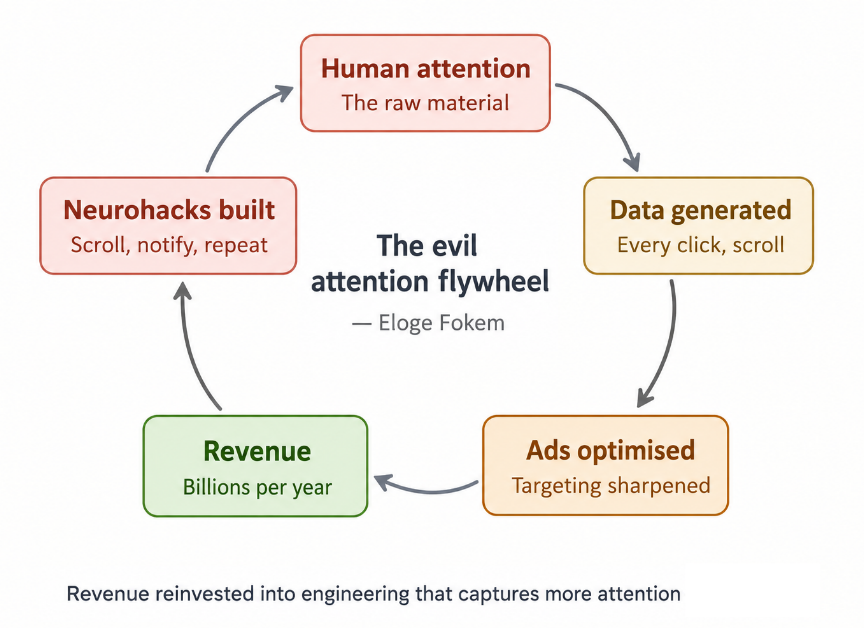
Fig1. The evil attention flywheel - Eloge Fokem
So we end up with a paradox that feels uncomfortable to me: technology that promised connection has produced a generation reporting record levels of loneliness, depression and anxiety. And then AI arrived with the promise of instant knowledge and intelligence. How exciting.
Observing around me how people use AI, I've noticed a very worrying trend, especially in Gen Z but not exclusively. Some have almost completely outsourced their thinking to ChatGPT. When asked a question they don't know the answer to, they reach for it without thinking first. Any somewhat complex task is automatically handed over to ChatGPT for guidance, no attempt to solve the issue by themselves. An existential doubt? Ask AI to confirm your existing bias. A friend of mine, single and searching, even rates her dates with the help of ChatGPT. "He didn't bring me flowers on the first date, when I had clearly mentioned in my bio that I like flowers, this is clearly a red flag, right?"
I am myself guilty of the same thing in a different way, though. I know more about the inner workings of LLMs; without being an expert, I know they just "spit" words probabilistically. However I've found myself many times in situations where I wanted my thinking to be double-checked, you know the "let me pick your brain" type of conversations you have with a friend about a topic, just to make sure you're thinking about it right? Yes, that friend was, well... Claude (the one from Anthropic, not my barber). The difference between me and my friend who uses ChatGPT to detect boyfriend potential is that I would use more advanced prompts avoiding confirmation bias and grounded in facts when applicable. Giving it good material from my own thinking and asking for blind spots, for example. The more heavy lifting you've done thinking about a topic, the better the quality of the questions you'll ask AI, resulting in quality answers and clear direction from it. This process has made some important decisions easier for me. At the end of the day, that's what tech is about, making human lives easier. Except, as the Christian that I am, I'm supposed to have a different framework to make decisions, especially important ones. Relying on God, acknowledging Him in everything that we do and seeking His guidance in life is central to our faith.
This clever, "all-knowing", instantly available and straightforward thing called AI had, in some cases, almost easily substituted for my reliance on God, God who doesn't always feel available and clear, by the way. It showed me that we humans can easily take something and insert it into our lives like it was always part of them, or let it infiltrate parts of our core systems. This is where the substitution happens. Who can blame us? Tech is supposed to serve us and evolve us, right? And that tech that feels like available intelligence outside our brains has a few interesting characteristics:
- All-knowing: you can ask it pretty much anything. All public human knowledge is available in natural language, effortlessly.
- Always on: you can "talk" to it anytime. It will answer your late-night doubts in seconds.
- Personalised: it keeps records of your conversations, it knows you. Its answers have your goals, fears and more as context.
- Anthropomorphised: it behaves like a human, can talk with natural-sounding voices and have a face if you want.
That last one is the playing ground of some new companies offering companionship with AI "friends". They claim things like "Build a meaningful friendship, develop a passionate relationship, or learn from an insightful mentor" or "Find a relationship that goes beyond friendship".
Do we stand a chance when that technology has all the properties needed to replace specific kinds of human processes and relationships?
We've been evolving already in an environment that has systematically outsourced thinking, AI is the logical conclusion of that trajectory. Before it, social media told us what to feel about things, recommendation engines told us what to watch, GPS told us how to get anywhere. We are moving towards a world where we outsource not just labor to AI, but thinking and validation.
I am uncertain about what this produces over time. A generation that has excellent AI-assisted output and a diminished capacity to sit with a hard question long enough to find their own answer. People who feel deeply understood by a system that is not, in any meaningful sense, understanding them.
I still believe AI is one of the most significant technologies humans have ever built, I use it almost daily. But I've started asking myself some questions: what does it replace, and was that thing worth replacing? What happens to the human soul when we no longer have to struggle to find answers?
What are you seeing in your own life or with people you know?
This article is the introduction to "The Substitution Machine" a series of essays on what technology is quietly replacing in us: our thinking, our relationships, our sense of self.
Part 1 is next: Men, loneliness, and the AI companion economy. Subscribe to receive it in your inbox.
Thanks for reading,
Eloge